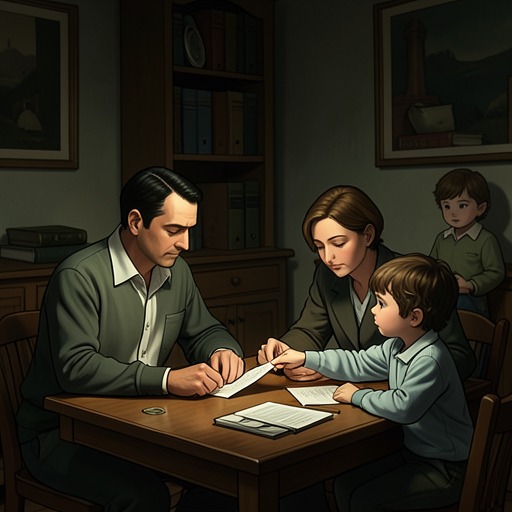
Fermina Daza and Juvenal Urbino’s marital crisis
Love in the Time of CholeraFermina Daza and Juvenal Urbino’s marital crisis is the defining rupture in their long marriage, exposing how a relationship regarded as stable can be unsettled by a breach of trust that neither spouse knows how to address. Fermina’s departure for Flores de María is at once an act of anger and a withdrawal into the place of her childhood; the nearly two years apart reveal the distance between outward civility and private hurt.
A crisis in a settled marriage
The crisis came late in the couple’s life together, when their children were grown and well behaved, and they believed the future was chiefly a matter of learning how to grow old without bitterness. It was the most serious marital crisis they had experienced in years of stable marriage, and it surprised them both. Rather than handle it through the public quarrels and intermediaries customary in the Caribbean, they tried to resolve it with what they took to be European wisdom. Their hesitation over which customs and loyalties to follow left them, instead, in a childish impasse: neither approach gave them a way out of the conflict.
The rupture grew from Fermina’s recognition that something had changed in Juvenal’s conduct. She had long relied on her acute sense of smell to navigate social life and ordinary domestic tasks. When she detected an unfamiliar odor on the clothes he had worn the previous evening, the sensation suggested to her that she had been in bed with another man. The discovery was not immediately an accusation: she first struggled to distinguish what was real from what might be illusion. But she later noticed that Juvenal had stopped taking Communion, including on Corpus Christi, and had missed his annual retreat. Since he had taken Communion faithfully since childhood, his evasive answer about these changes became a decisive indication to her that he was persisting in a serious sin.
Fermina’s departure
Fermina eventually decided that she had to leave in order to escape the suffering the discovery had caused her. She went not on the ocean liner bound for Panama that people might have expected, but on the regular boat to San Juan de la Ciénaga, the city where she had been born and lived until adolescence. Her longing for the place had strengthened over the years. She left at midnight, secretly, with her face covered by a black mantilla, accompanied only by her fifteen-year-old goddaughter, who had been raised as a family servant. Although Fermina defied her husband’s wishes and the conventions of the time, the ship captains and officials at each port had been informed of her journey.
She told her children she would spend about three months with Aunt Hildebranda, but she had no settled intention of returning. The account presents the decision as born of sheer fury, not as a fully worked-out plan: Fermina herself did not know why she was leaving or what she meant to accomplish. Juvenal knew the force of her character and accepted her decision with humility, interpreting it as punishment for the gravity of his own sins. Yet before the boat’s lights had disappeared, both regretted their weakness. Regret did not immediately bridge the distance between them; pride kept each from finding a way back.
Separation and the effort to return
During the separation, Fermina settled at the ranch near Flores de María, where her cousin Hildebranda Sánchez lived, and appeared content with her new life. The children spent a school vacation there, and Juvenal learned of Fermina’s apparent contentment through their son’s letters. The impression did not mean that the marriage had been resolved. For almost two years, Fermina and Juvenal maintained only formal correspondence about their children and household matters, while neither found a path back that did not threaten to reopen the wound through pride.
The distance also produced a strikingly indirect form of communication. During a pastoral visit, the Bishop of Riohacha came to Hildebranda’s ranch amid the pilgrims and festivities surrounding his visit. After lunch, he asked Fermina to make her confession. She refused amiably but firmly, saying that she had nothing to repent of. She did not consciously intend the refusal as a message to her husband, yet she was certain it would reach the appropriate ears. The gesture sharpened the crisis’s moral dimension: Juvenal’s conduct had become a matter of conscience for Fermina, but she would not accept the position of a penitent merely to restore domestic peace.
Trust, habit, and private knowledge
The episode also brings into focus how long-standing domestic habits became newly charged by suspicion. Juvenal had known that Fermina smelled clothing to decide whether it needed washing, even when it looked clean, and that she used the same perceptive faculty in other areas of life. He had seen her discover their missing young son, asleep in an armoire, by tracking him through smell. What he had regarded as an eccentric habit was also, in his view, part of the instinct that had helped her find her way through a society prejudiced against her. During the marital crisis, that sense of smell turned from a practical and social faculty into the first sign of betrayal.
Fermina’s way of dealing with what she did not want to discuss had also been to treat it as a joke. That habit could no longer contain the pain: she resolved that she had to confront what she believed was poisoning her. The crisis is thus not simply a dispute over an absent explanation. It changes the meaning of familiar signs—the clothes, Juvenal’s religious observances, and Fermina’s own private observations—and turns the domestic knowledge accumulated over a lifetime into evidence that their trust has been broken.
Aftermath and significance
The marriage’s return from separation is not presented as an easy reversal of Fermina’s decision. The formal letters, the children’s visits, and the indirect signal through the Bishop all show contact continuing without intimacy. The crisis occupies the space between a long-established household and a rupture neither spouse can quickly overcome: Fermina has left, Juvenal accepts her choice, and both regret the separation, but pride delays any return.
Later, the crisis remains part of the history through which others judge Fermina’s choices. After she comes back from Flores de María, Hildebranda visits her, and the cousins revisit memories of their youth. Still later, when Fermina’s daughter Ofelia condemns the renewed companionship between her mother and Florentino Ariza as indecent, Fermina expels her from the house. The distinction between these episodes matters: the marital crisis is an earlier separation from Juvenal, while Fermina’s later defense of love in old age concerns her relationship with Florentino. Together, the episodes show Fermina refusing to let other people’s judgments dictate the terms of her private life, even as the consequences of marriage, fidelity, and social respectability remain difficult to escape.